Ask most chefs about food safety for pregnant guests and you’ll get a list of what to avoid. Ask about the numbers — the actual core temperatures, holding times and cooling windows — and the answers get vaguer. Yet those numbers are where pregnancy-safe cooking actually happens.
This guide is for restaurant operators and kitchen teams. It’s also useful reading for pregnant diners who want to understand what “cooked through” really means when they ask for it.
Why pregnancy raises the bar
Pregnancy alters immune function in ways that make certain infections both more likely and more severe. Listeria monocytogenes is the clearest example: it can cross the placental barrier, and pregnant women are markedly more susceptible than the general population. Toxoplasma gondii, Salmonella and Campylobacter complete the short list of pathogens worth building your protocols around.
The good news for kitchens: all four are heat-sensitive. Correct cooking is not a partial mitigation — it is the control point.
Core temperatures that matter
Temperature alone doesn’t tell the whole story. Pathogen reduction is a function of temperature and time: a lower temperature held longer can achieve the same log reduction as a higher temperature held briefly. But in a busy service, simple targets beat elegant curves.
Poultry
Cook to a core temperature of at least 74°C / 165°F, verified at the thickest point away from bone. No pink at the joint, juices running clear. For pregnant guests this is non-negotiable — poultry is the leading vehicle for Campylobacter.
Minced and ground meat
Mincing distributes surface bacteria throughout the product, so a seared exterior means nothing. Target 71°C / 160°F core. Burgers served pink should never be offered to a pregnant guest, and your service team should know how to say so.
Whole cuts of beef, pork and lamb
Whole muscle is contaminated on the surface only, which is why a rare steak is normally lower risk than a rare burger. For pregnancy, though, Toxoplasma cysts can sit within the muscle tissue itself. Serve pregnant guests whole cuts cooked to at least 71°C / 160°F throughout.
Fish and seafood
Target 63°C / 145°F core, until the flesh is opaque and flakes cleanly. Raw preparations — sashimi, ceviche, tartare — should be excluded from pregnancy-safe menus regardless of freezing treatment, since blast freezing addresses parasites but not bacterial contamination.
Eggs
Both white and yolk should be firm. Pasteurised egg products are the practical solution for sauces, mayonnaise, mousses and desserts that would otherwise rely on raw egg.
Reheated dishes
Bring to at least 75°C / 167°F throughout, once only. Steaming hot, not warm. Reheating is where otherwise excellent kitchens most often slip.
The danger zone, and how to move through it fast
Between 5°C and 63°C bacteria multiply. The professional goal is to spend as little time there as possible.
- Cooling: from 63°C to 21°C within two hours, then down to 5°C within a further four. Shallow pans, blast chillers, ice baths — anything that beats leaving a stockpot on the counter.
- Hot holding: above 63°C, continuously, with temperature logged.
- Cold holding: at or below 5°C. This matters more than people assume, because Listeria grows at refrigeration temperatures — slowly, but it grows.
That last point is why a pregnancy-safe kitchen keeps ready-to-eat items on tight rotation rather than trusting the fridge to freeze time.
Measure it, don’t guess it
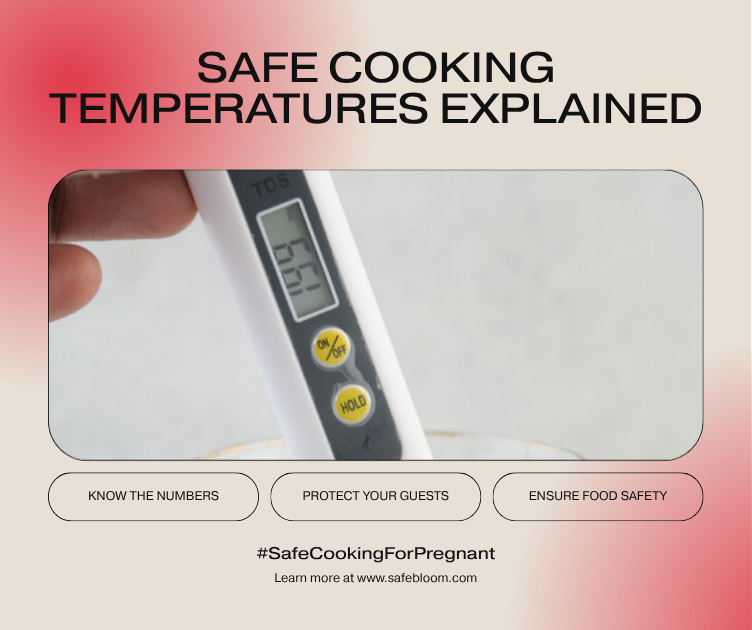
Colour is an unreliable indicator. Ground beef can turn brown well below a safe core temperature, and can stay pink well above it, depending on pH and packaging. A calibrated probe thermometer is the only honest answer.
Practical protocol: calibrate probes weekly in an ice-water slurry (should read 0°C ± 1°C), sanitise between every measurement, and probe the thickest part of the product away from bone or pan contact. Record readings — not for the inspector, but because a written record turns a habit into a system.
Cross-contamination: the invisible failure
Perfect cooking temperatures are undone by a single shared board. For pregnancy-safe service, colour-coded boards and knives, separate preparation zones for raw and ready-to-eat, and dedicated handling of unpasteurised products are the baseline. Store raw proteins below ready-to-eat items, never above.
Turning protocol into service
Documentation matters, but so does communication. A pregnant guest shouldn’t have to interview the server to feel safe. The kitchens that get this right do three things: they mark suitable dishes on the menu, they train front-of-house on which questions to expect, and they treat “can this be prepared pregnancy-safe?” as a normal modification request rather than an inconvenience.
The commercial logic follows quickly. A pregnant guest usually isn’t dining alone — she brings a partner, a family, a group. Being the restaurant that can confidently say yes is worth considerably more than the cost of the protocol.
Where to start
If your kitchen already runs solid HACCP, you are most of the way there. Pregnancy-safe service is HACCP with a sharper focus on a specific vulnerable group and clearer communication at the table.
Our SafeBloom Pregnancy-Safe Restaurant certification course walks kitchen and service teams through the full protocol, from menu audit to staff scripts. Certified venues appear in our public directory of pregnancy-safe restaurants, and guests can verify any certification in seconds. Already certified? Download assets from the marketing kit to make it visible to the guests who are looking for you.