
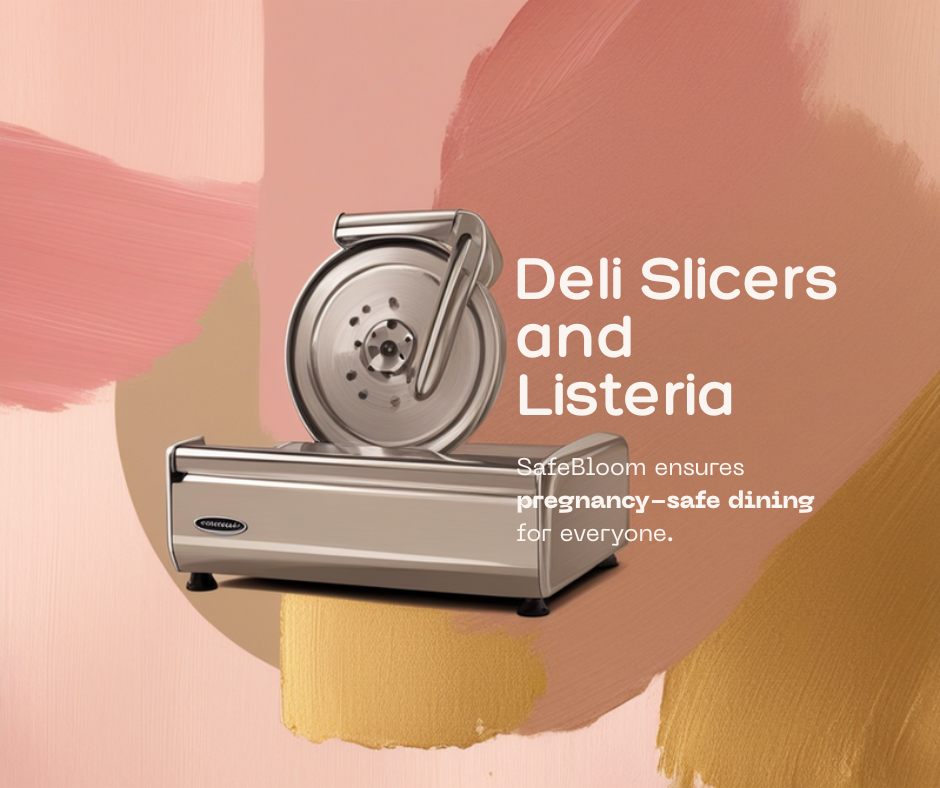
Ask a chef which piece of equipment worries them most from a food-safety standpoint and most will say the walk-in fridge or the fryer. Ask a food-safety inspector and you will hear a different answer: the deli slicer. In outbreak investigations across Europe and North America, slicers are repeatedly identified as the point where Listeria monocytogenes moves from one ready-to-eat product to dozens of others. For a pregnant guest, that transfer is not an abstract risk. It is the single most plausible way a restaurant serves her a dangerous plate without anyone breaking an obvious rule.
This article explains why slicers are so effective at spreading Listeria, and lays out a cleaning and handling protocol that any kitchen can adopt in a week.
Why slicers are a Listeria highway
A slicer has dozens of surfaces that food touches but the eye never sees: the blade guard, the back of the blade, the carriage slide rods, the ring guard, the food chute, the blade-mount seals. Meat juice, cheese fat and moisture collect in those gaps, and the machine runs at room temperature all day. That combination is exactly what Listeria needs to form a biofilm, a protective layer that resists routine wiping and ordinary sanitiser.
Once a biofilm is established, every product that passes over the blade picks up cells. Cured ham, roast turkey, smoked salmon, aged cheese: none of these will be cooked again before service, so there is no kill step between the blade and the guest’s plate.
The four-hour rule
Most European food-safety guidance, and the US FDA Food Code, converge on the same standard: a slicer in continuous use with ready-to-eat foods must be fully cleaned and sanitised at least every four hours, not just at the end of the day. Four hours is roughly the time it takes Listeria and other pathogens to multiply to significant levels at room temperature on a soiled surface.
A slicer protocol built for pregnant guests
Below is the protocol we recommend to restaurants preparing for SafeBloom certification. It is deliberately stricter than the legal minimum, because the guest we are protecting is the most vulnerable one in the dining room.
1. Disassemble, do not just wipe
A full clean means removing the blade guard, the product table, the carriage, the pusher and any deflector, then washing each part separately. Wiping the exposed blade with a cloth is a surface clean and does nothing for the seals and slide rods where biofilm lives. The manufacturer’s manual shows which parts come off; laminate that page and hang it next to the machine.
2. Follow the correct sequence
- Unplug and set the blade thickness to zero.
- Remove loose debris with a disposable paper towel.
- Wash all parts and the body with hot water and detergent.
- Rinse with clean water to remove detergent, which otherwise neutralises the sanitiser.
- Sanitise with a food-grade sanitiser at the concentration on the label, respecting the contact time (typically 1-5 minutes). Do not rinse it off unless the product requires it.
- Air dry before reassembly. Drying with a cloth reintroduces bacteria.
3. Separate products, or sequence them
Ideally, one slicer for meat and one for cheese. Where that is not realistic, slice cheese first and cured meats second, and always clean between raw-cured products and cooked products. Never slice anything on a machine that has been used for raw meat without a full clean first.
4. Inspect the seals monthly
Cracked or worn seals around the blade mount are an inspection red flag in their own right. Listeria colonises damaged gaskets faster than any other surface on the machine. Replace them on a schedule, not when they visibly fail.
5. Log it
A simple sheet next to the slicer with time, operator initials and “full clean completed” is enough. Inspectors ask for it, and it is the fastest way for a manager to notice that the mid-shift clean is being skipped on busy days.
What this means for the pregnancy-safe menu
Even with a perfect protocol, some sliced ready-to-eat products remain outside what most guidelines consider safe in pregnancy: cold-smoked fish, unpasteurised soft cheeses, raw cured meats such as prosciutto crudo or salami. A rigorous slicer routine reduces cross-contamination, but it does not turn a high-risk product into a low-risk one.
The practical approach for a restaurant is to build a short list of dishes that can be confidently offered to a pregnant guest: cooked ham sliced on a freshly cleaned machine, pasteurised hard cheeses, roast meats sliced to order. Front-of-house should know which dishes those are, and why.
Communicating the protocol to guests
Pregnant diners rarely ask about slicers, but they do ask “is the ham safe?” A server who can answer “our slicers are fully cleaned every four hours and we serve cooked ham to pregnant guests, never raw cured meat” gives a precise, reassuring answer that most competitors cannot match.
Cross-contamination control on ready-to-eat equipment is one of the points SafeBloom verifies before a restaurant is certified. If you want a step-by-step framework covering slicers, cold chain, labelling and staff training, it is all in the SafeBloom Certified Pregnancy-Safe Restaurant course. Already certified? Use the marketing kit to let expecting mothers know. And if you are the one expecting, find a kitchen that has already done this work in our directory of certified restaurants.