
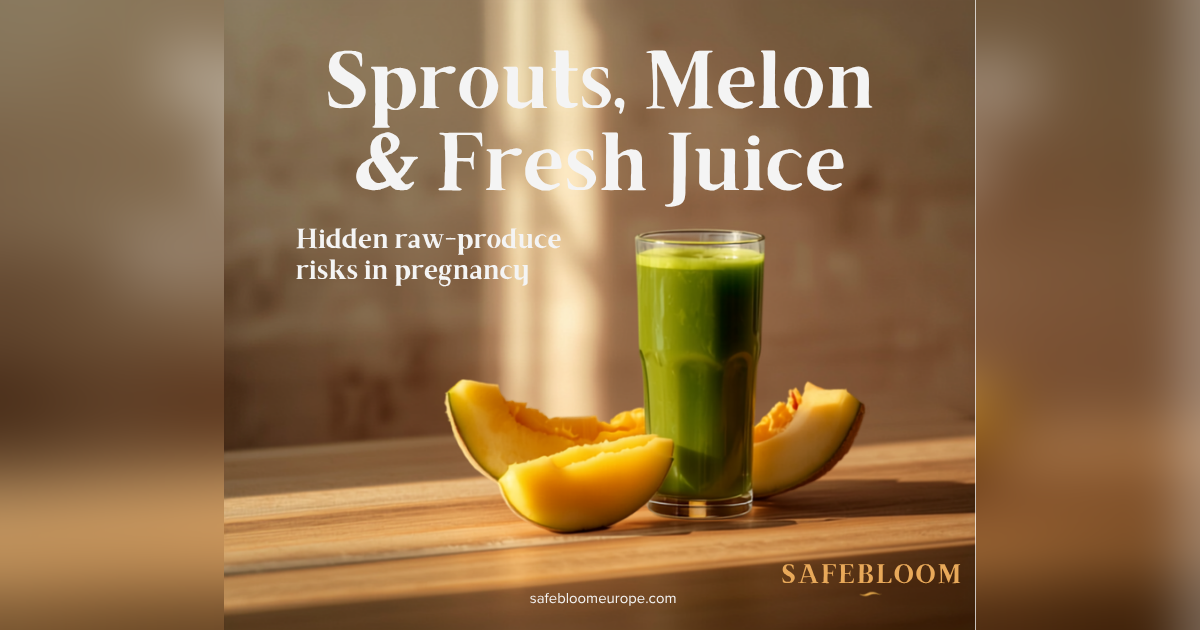
Most pregnancy food-safety advice focuses on the obvious suspects: soft cheese, raw fish, undercooked meat. But some of the highest-risk items on a restaurant menu look completely harmless. Sprouts on a poke bowl. A fruit plate at brunch. Fresh-pressed juice at the counter. The basil on your bruschetta. This article looks at the raw produce categories that European food-safety agencies flag most often, why they matter specifically in pregnancy, and how to handle them when eating out.
Why raw produce needs its own conversation
Raw plant foods carry pathogens from soil, irrigation water, animal contact and handling. Unlike meat, there is no cooking step to kill them. Three organisms matter most for pregnant diners: Listeria monocytogenes (grows at fridge temperature, can cross the placenta), Toxoplasma gondii (soil-borne, congenital infection risk) and Shiga-toxin E. coli (severe gastroenteritis, dehydration). Each of the items below has a documented track record with at least one of them.
1. Raw sprouts and microgreens
Sprouts are the single most consistently flagged raw vegetable in international food-safety guidance. The reason is structural: seeds are germinated in warm, humid conditions for several days, which is exactly the environment bacteria need to multiply. If the seed carries Salmonella or E. coli, sprouting turns a few cells into millions. The 2011 German STEC outbreak, traced to fenugreek sprouts, remains one of the largest foodborne outbreaks in European history.
Washing does not help, because the bacteria are inside the sprout tissue, not on the surface. The only safe preparation is thorough cooking. Microgreens are lower risk than sprouts (they grow in soil or substrate, not in water, and are harvested above the root) but still belong in the “ask before you eat” category.
At the restaurant: bean sprouts in pad thai or pho are usually added raw or barely warmed. Ask for them left out, or ask for the dish fully cooked. Alfalfa, radish and mung sprouts on sandwiches, bowls and salads: skip them.
2. Pre-cut melon and fruit platters
Whole fruit with an intact peel is very safe. The problem starts with the knife. Melons in particular grow on the ground, so the rind carries soil bacteria; when the fruit is cut, the blade drags Listeria or Salmonella from the rind into the sweet, low-acid flesh. Cantaloupe has a near-neutral pH, which lets bacteria grow far more readily than in citrus or berries.
A fruit platter that sits on a brunch buffet for two hours at room temperature is the worst-case scenario. Melon cut to order and served immediately is fine.
At the restaurant: favour whole fruit you peel yourself, or fruit that is high-acid (citrus, pineapple, berries). If melon is on the menu, ask whether it is cut fresh per order.
3. Unpasteurised juices and smoothies
“Fresh-pressed”, “cold-pressed” and “raw” juice all mean the same thing from a safety standpoint: no heat treatment, no HPP, no kill step. Whatever was on the fruit or vegetable skin is now in the glass, concentrated. Outbreaks of E. coli and Salmonella linked to unpasteurised apple and orange juice are well documented.
The risk is manageable if the operator washes and sanitises produce properly and serves the juice immediately. It becomes significant if juice is pre-batched and held for hours, which is common in cafés and hotel breakfast rooms.
At the restaurant: ask whether the juice is made to order. Bottled juices labelled “pasteurised” or “HPP-treated” are the safe default. Smoothies made with frozen fruit and pasteurised dairy or plant milk are fine.
4. Fresh herbs and leafy garnishes
Basil, coriander, parsley and mint are delicate, hard to wash thoroughly, and frequently handled with bare hands at the pass just before service. Multi-country outbreaks in Europe have been traced to imported fresh herbs. The quantity on a plate is small, which lowers the dose, but herbs added after cooking are effectively a raw ingredient.
At the restaurant: herbs cooked into a sauce are safe. A generous handful of raw coriander on a curry, or basil leaves placed on a pizza after it leaves the oven, is a judgement call; in a certified kitchen with proper herb washing it is low risk, elsewhere it is reasonable to ask for it to be left off.
5. Salad bars and open self-service
Everything above gets worse when it is left in open containers at room temperature, touched by many customers and topped up rather than replaced. Salad bars combine raw produce, time, temperature abuse and cross-contact between items. In pregnancy, they are best avoided regardless of how clean the restaurant looks.
What a well-run kitchen does differently
Restaurants that take pregnancy safety seriously handle raw produce with the same rigour as raw meat: three-stage washing with a food-grade sanitiser, colour-coded boards, cut-produce holding limits of 24 hours at or below 4 °C, sprouts either cooked or not stocked at all, juices made to order. These are the exact controls assessed in the SafeBloom Pregnancy-Safe certification, and they are what separates a restaurant that says it is careful from one that can show it.
Quick reference for pregnant diners
- Safe: cooked vegetables, whole fruit you peel, high-acid fruit, pasteurised or HPP juice, herbs cooked into dishes.
- Ask first: pre-cut melon, fresh-pressed juice, raw herb garnishes, microgreens.
- Avoid: raw sprouts, salad bars, fruit platters held at room temperature.
Eating out while pregnant should not feel like a risk assessment. If you would rather not run through this list every time, find a SafeBloom-certified restaurant in our directory, where produce handling has already been verified. Restaurant owners who want to earn that trust can start with the certification course, and use the SafeBloom marketing kit to let expectant guests know their kitchen is ready for them.