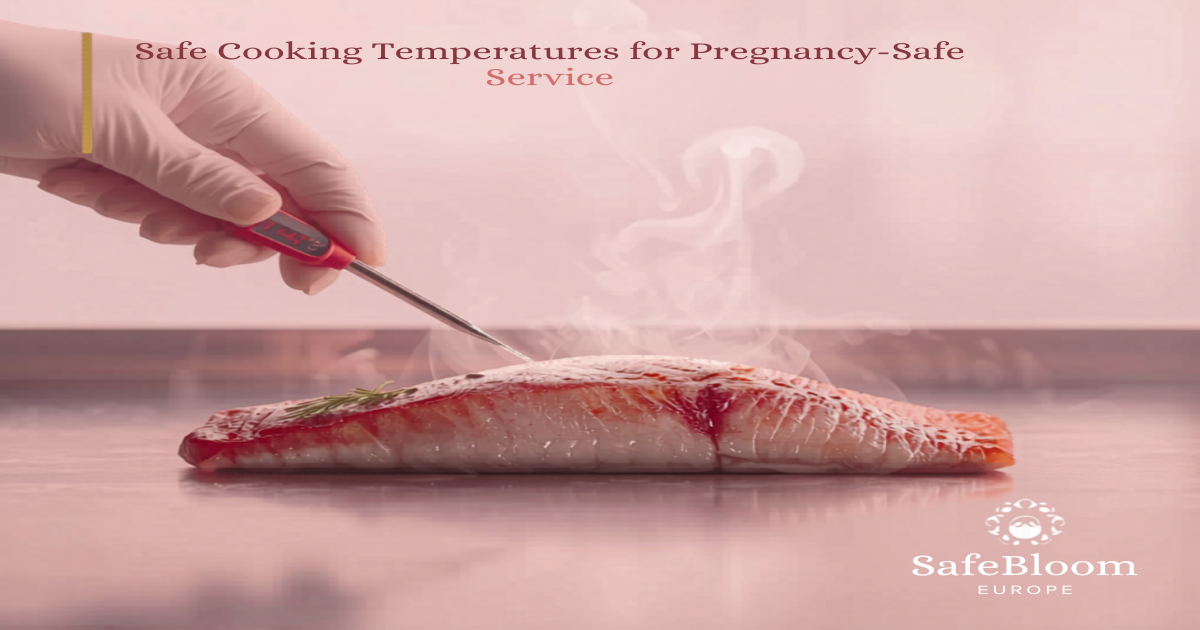
For most diners, a beautifully plated steak ordered “medium-rare” is part of the restaurant experience. For a pregnant guest, that same dish — or the eggs in her hollandaise, or the salmon in her brunch — sits in a different category of risk. Foodborne pathogens that healthy adults usually clear without incident can cross the placenta and cause miscarriage, preterm birth, or congenital infection. The single most powerful tool a restaurant has to protect those guests isn’t an ingredient list. It’s a thermometer.
Why temperature is the front line of pregnancy-safe service
Three pathogens drive nearly all the pregnancy-specific warnings issued by European food safety authorities: Listeria monocytogenes, Toxoplasma gondii, and Salmonella enterica. Each of them can be reduced to undetectable levels by proper thermal treatment — but each requires a specific minimum core temperature, held for a specific minimum time. Approximations don’t work. “Looks done” is not a food safety standard.
Listeria, in particular, is the only common foodborne pathogen that continues to multiply at refrigeration temperatures. That means a contaminated product can become more dangerous overnight in a properly working cold room. Heat, applied correctly, is the only reliable kill step.
The temperature targets that matter for pregnant guests
The European Food Safety Authority (EFSA) and national agencies converge on a consistent set of minimum core temperatures. These are the numbers your kitchen team should know by heart.
Poultry: 74 °C (165 °F) core, no resting reduction
Chicken, turkey, duck, and game birds carry the highest Salmonella and Campylobacter loads of any commonly served protein. Pink-tinted meat near the bone is acceptable for healthy adult diners only if the core reading is 74 °C; for pregnant guests, do not rely on visual cues. Probe the thickest part of the thigh joint, not the breast.
Ground meats and mixed preparations: 70 °C (158 °F) for 2 minutes
Burgers, meatballs, sausages, terrines, ragù, and any preparation where surface bacteria have been mechanically distributed throughout the product. The “still pink in the middle” burger is incompatible with pregnancy-safe service. Hold the core temperature for at least two minutes — a quick spike is insufficient.
Whole-muscle red meat: 63 °C (145 °F) for 3 minutes, well-done equivalent
Steak, lamb chops, pork tenderloin. Healthy adult guests can be served at lower temperatures because surface bacteria are seared off. For a pregnant guest, the same cut should be cooked through. Communicate this clearly to the diner — many pregnant guests want to know why their steak arrives more done than usual.
Fish and seafood: 63 °C (145 °F) core, opaque throughout
This is the single most underestimated category. Salmon, tuna, sea bass, and shellfish must all reach 63 °C internally. That makes sushi, sashimi, ceviche, cold-smoked salmon, tartares, and rare-seared tuna unsuitable for pregnant guests as-served. Offer cooked alternatives proactively — a well-prepared baked or grilled fish is not a downgrade.
Eggs: yolk and white fully set, or pasteurised liquid egg
This affects more dishes than most chefs initially realise. Carbonara, hollandaise, mayonnaise, aioli, tiramisù, mousses, soft-boiled eggs, eggs Benedict, sunny-side-up: all carry Salmonella risk unless prepared with pasteurised liquid egg products. Keep pasteurised egg in stock specifically for pregnancy-safe orders, and brief service staff to identify the affected menu items.
Reheating: 75 °C (167 °F) core, single reheat only
Any pre-cooked product served warm — soups, sauces, stuffed pasta fillings, braised dishes, sliced meats reheated on the plancha — must reach 75 °C before reaching the pregnant guest’s plate. Reheat once. A product that has been heated, cooled, and reheated twice is no longer safe and should be discarded.
Building the kitchen workflow around it
Knowing the targets is not enough. The targets have to be embedded in the kitchen’s daily rhythm. Three practical disciplines separate compliant kitchens from genuinely pregnancy-safe kitchens:
Calibrate every probe weekly. A 2 °C drift on a digital thermometer is the difference between “Listeria killed” and “Listeria surviving.” Run an ice-bath check (0 °C) and a boiling-water check (100 °C, adjusted for altitude) every Monday morning before service.
Log readings for pregnancy-safe orders. A simple sheet that records dish, core temperature, and time of probe creates accountability and produces evidence if a complaint ever arises. This is the same logic as HACCP critical control points, applied at the order level.
Train front-of-house to confirm, not negotiate. When a guest discloses pregnancy and asks about a dish, the answer should be a clear “this dish is prepared at 70 °C core — yes, it’s safe” or “this dish includes raw egg — let me suggest an alternative.” Hedging undermines the trust the guest is extending to your restaurant.
Why this differentiates your restaurant
Pregnant guests don’t just eat once. They book birthday meals, anniversary dinners, baby showers, and post-natal celebrations. The restaurant that earns their trust during pregnancy becomes the family restaurant for the years that follow. Word travels through antenatal groups, hospital networks, and parenting communities faster than any marketing campaign.
Investing in a clearly documented, temperature-driven pregnancy-safe protocol is a small operational change with a long commercial tail. It also protects your liability profile — a documented kill-step protocol is the strongest defence against a foodborne illness complaint involving a vulnerable guest.
This is precisely the operational discipline the SafeBloom Certified Pregnancy-Safe Restaurant programme teaches: not generic food safety, but the specific temperatures, workflows, and guest-communication standards that pregnant guests recognise as real care. Certified restaurants appear in our public directory and can be verified by any guest before they book.
A thermometer is not a glamorous tool. But for pregnant guests, it’s the most honest promise a kitchen can make. Ready to make that promise visible? Enrol your restaurant in the SafeBloom certification and join the network of European venues that pregnant diners actively seek out.