
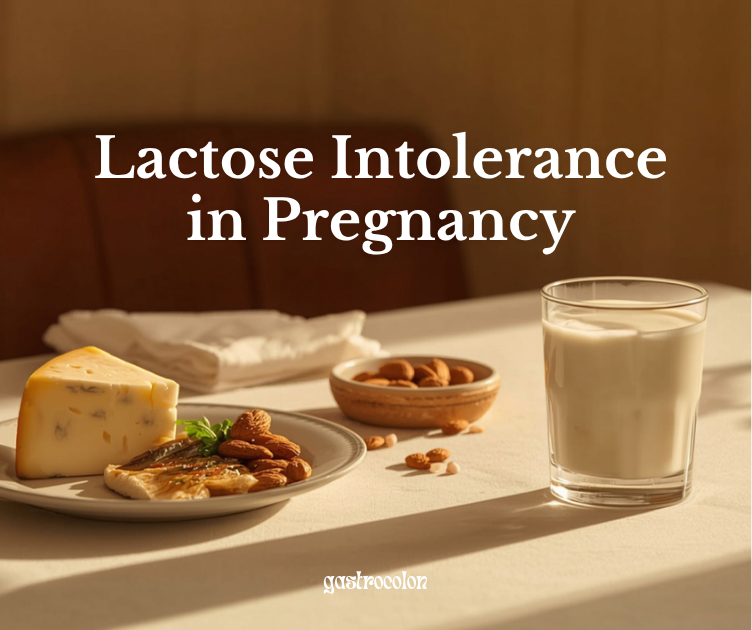
Calcium is one of the headline nutrients of pregnancy. Your baby’s skeleton is built almost entirely from the calcium you consume, and if intake falls short, your body will draw on your own bone reserves to make up the difference. For most women, dairy is the easiest route to the roughly 1,000 mg a day recommended across Europe. But for the many women who are lactose intolerant, a glass of milk or a creamy dessert comes with a price.
Add restaurants to the equation, where you don’t control the ingredients, and the challenge grows. This guide covers what lactose intolerance actually is, why it sometimes changes during pregnancy, which dairy foods you can probably still enjoy, and how to eat out without giving up on calcium.
What lactose intolerance is, and what it is not
Lactose intolerance is a digestive condition, not an allergy. It happens when the small intestine produces too little lactase, the enzyme that breaks down lactose, the natural sugar in milk. Undigested lactose travels to the colon, where bacteria ferment it and produce gas, bloating, cramps and diarrhoea.
This distinction matters at the table. A cow’s milk protein allergy is an immune reaction that can be severe and requires strict avoidance. Lactose intolerance is a matter of degree: most people can tolerate small amounts, and many dairy foods contain very little lactose in the first place. Understanding this gives you far more freedom when ordering.
Does pregnancy change lactose tolerance?
Interestingly, yes, for some women. Several small studies have found that lactose tolerance can improve during the second and third trimesters, likely because slower gut transit gives residual lactase more time to work and changes in the gut microbiome help ferment lactose more gently. Other women report the opposite, particularly in the first trimester when nausea makes everything harder to tolerate. The practical takeaway: your tolerance may not be what it was before pregnancy, so test cautiously rather than assuming.
Why calcium matters so much right now
During pregnancy, your intestine roughly doubles its efficiency at absorbing calcium, a clever adaptation to the baby’s needs. But that only helps if calcium is on the plate. Inadequate intake is associated with higher risk of pregnancy-induced hypertension and pre-eclampsia, and with reduced maternal bone density after delivery. The World Health Organization recommends calcium supplementation in populations with low dietary intake specifically because of the pre-eclampsia link.
Calcium also needs vitamin D to be absorbed, so the two should be considered together. If you are avoiding dairy entirely, speak with your midwife or doctor about whether a supplement is appropriate. Meanwhile, restaurant choices can do a lot of the work.
Dairy you can probably still enjoy
Lactose content varies enormously across dairy products. This is the single most useful thing a lactose-intolerant woman can know when reading a menu.
- Hard, aged cheeses such as Parmigiano Reggiano, Grana Padano, aged Gouda, Comté, Gruyère, Manchego and mature Cheddar contain virtually no lactose. During ageing, the lactose is fermented away almost completely. These cheeses are also pasteurised or made from raw milk but aged well beyond the point where pathogens survive, making them pregnancy-safe as well as gut-friendly. Thirty grams of Parmigiano delivers around 350 mg of calcium.
- Yogurt and kefir contain live cultures that pre-digest much of the lactose. Many people who cannot drink milk tolerate yogurt well. Choose pasteurised versions.
- Butter is almost pure fat and contains only trace lactose. A dish cooked in butter is rarely a problem.
- Lactose-free milk is increasingly available in European cafés and restaurants. It is regular milk with the lactase enzyme added, so it delivers full calcium.
The foods to approach carefully are fresh milk, cream, ice cream, soft fresh cheeses like ricotta and mascarpone, and cream-based sauces and soups. These are where lactose concentrates.
Non-dairy calcium on restaurant menus
Plenty of restaurant dishes deliver calcium without any dairy at all:
- Canned or fully cooked fish with soft bones: sardines and anchovies are excellent sources, and both are low in mercury. A Mediterranean sardine dish can provide 300 mg or more.
- Tofu set with calcium, common in Asian restaurants, is one of the richest plant sources.
- Leafy greens such as kale, bok choy, broccoli and rocket. Spinach contains calcium too, but its oxalates block most of it.
- Legumes: white beans, chickpeas and lentils, often the base of soups and side dishes.
- Tahini and sesame: hummus, sesame-crusted dishes, and many Middle Eastern preparations.
- Almonds and almond-based sauces or desserts.
- Fortified plant milks in coffee bars: oat, soy and almond drinks fortified with calcium carbonate deliver comparable amounts to cow’s milk. Ask whether the brand is fortified.
Reading the menu and talking to your server
Restaurants are getting better at handling dietary needs, but lactose is still often confused with milk allergy, or ignored altogether. A few questions can save you an uncomfortable evening.
Questions that get useful answers
- “Is this sauce cream-based or stock-based?” Many risottos, pasta sauces and soups are finished with cream that isn’t listed.
- “Which cheese is used in this dish?” Aged hard cheese is usually fine; fresh soft cheese may not be.
- “Do you have lactose-free milk or a fortified plant milk for coffee?”
- “Can the dish be made without the cream, or with olive oil instead of butter?” Most kitchens will accommodate this readily.
- “I’m pregnant as well. Are the soft cheeses pasteurised?” This one addresses food safety, not lactose, but it is worth asking in the same breath.
Under EU Regulation 1169/2011, milk is one of the 14 allergens that restaurants across the European Union must be able to identify in every dish on request. That means the kitchen should be able to tell you exactly where dairy appears, even if lactose content specifically isn’t tracked.
Cuisines that make it easier
Japanese, Thai, Vietnamese and many Middle Eastern cuisines use little or no dairy, and often feature calcium-rich tofu, sesame, small fish and leafy greens. Just remember the pregnancy rules still apply: cooked fish rather than raw, and avoid unpasteurised ingredients. Italian and French restaurants are dairy-heavy but also offer the aged cheeses that most lactose-intolerant people tolerate well.
For restaurants: a small step with real impact
Lactose intolerance affects an estimated two-thirds of adults worldwide, with wide variation across Europe: from under 10 per cent in Scandinavia to well over half in parts of southern Italy and Greece. Combined with pregnancy, it creates a customer who is highly motivated to find restaurants that understand her needs, and highly loyal once she does.
Simple measures make a difference: keeping lactose-free milk in stock, noting cream-based sauces on the menu, training servers to distinguish intolerance from allergy, and being able to swap butter for olive oil on request. Restaurants that go through the SafeBloom Pregnancy-Safe certification already train staff to handle allergen and dietary questions with precision; the same skill set serves lactose-intolerant guests just as well.
Key takeaways
Being lactose intolerant during pregnancy does not mean going short on calcium or giving up eating out. Aged hard cheeses, yogurt, fortified plant milks, small oily fish, tofu, legumes and leafy greens all deliver calcium without the discomfort. Ask about cream and cheese types, choose cuisines that suit you, and treat your tolerance as something to test gently rather than assume.
Looking for a restaurant that takes pregnancy dietary needs seriously? Browse the SafeBloom certified restaurant directory or verify a restaurant’s certification before you book. Restaurant owners can learn more about the SafeBloom Pregnancy-Safe certification course and the marketing kit for certified venues.