Ask a kitchen team which ingredients carry food-safety risk for pregnant guests and you will hear the usual list: soft cheese, cured meats, raw fish, runny eggs. Flour rarely makes the list. Yet it sits in every kitchen, and because it is a raw agricultural product rather than a ready-to-eat food, it deserves a place in your HACCP thinking. This article looks at raw flour and uncooked dough from the restaurant’s side of the pass: where the risk comes from, where it hides on a menu, and what a simple, documented routine looks like.
What the risk actually is
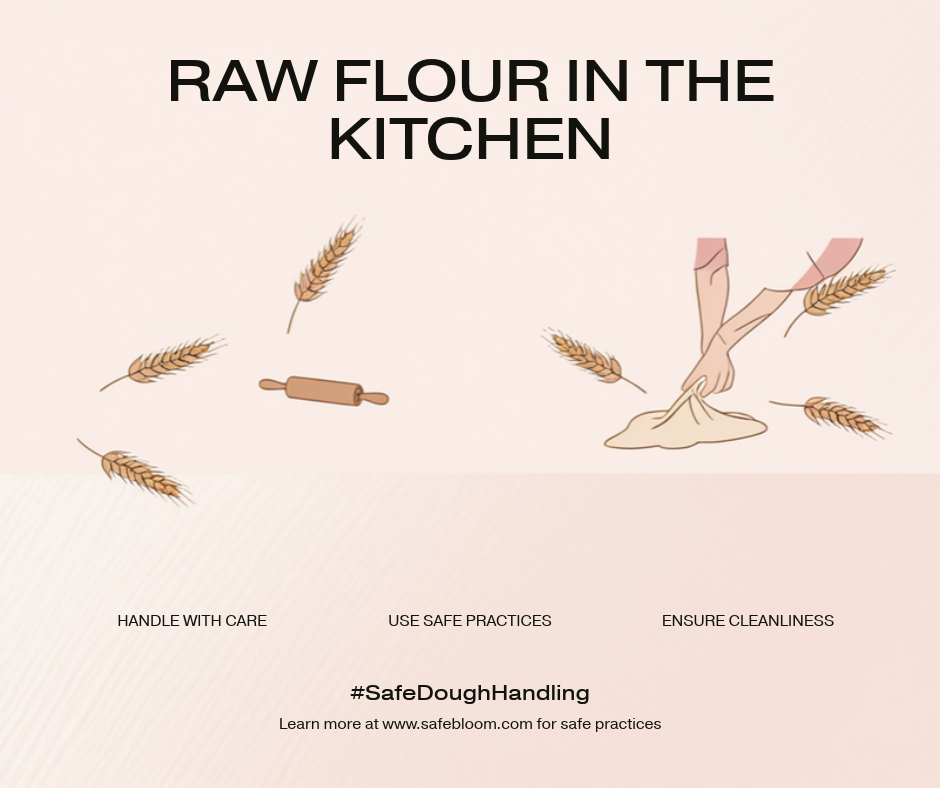
Flour is milled from cereals grown in open fields. Milling does not include a step designed to eliminate pathogens, so safety relies on the cooking that happens later. Public health bodies in several countries, including Germany’s Federal Institute for Risk Assessment (BfR), have reported infections with Shiga toxin-producing E. coli (STEC) linked to eating raw dough, and advise against tasting uncooked flour or dough.
For pregnant guests, gastrointestinal infections are best avoided: vomiting, diarrhoea and dehydration are harder to manage during pregnancy. The practical rule for your menu is simple: flour-based mixtures are served only when fully cooked.
Where raw flour hides on a restaurant menu
No-bake and “trend” desserts
Edible cookie dough, no-bake cheesecake bases and similar desserts are the clearest hazard. If a dessert contains flour that has not been baked or heat-treated, mark it clearly or offer a pregnancy-friendly alternative. If you use heat-treated flour, make sure the supplier documents it and that your team can say so.
Under-baked centres
Thick focaccia, filled calzoni, stuffed breads and dense cakes can look finished while the centre is still doughy. A probe thermometer and a defined check (centre reaches the temperature set in your procedure, texture is set, not gummy) turns a guess into a habit.
Batters and coatings
Tempura, beer batter and breaded items are safe when the oil is at the right temperature and the product is cooked through. Fryer temperature logs and oil-change schedules belong in the same record as your other critical controls.
Tasting and shared surfaces
Raw dough tasted by staff, dusting flour on shared benches and unwashed scoops moving between flour bins and ready-to-eat items are all routes for cross-contamination. Pastry stations that prepare cold desserts should be separated, in practice and in schedule, from dough handling.
A five-point routine for the kitchen
- Cook it through: define the target for doughs and batters, check it, and record it.
- No tasting raw: make “no raw dough or flour tasting” a standing rule in staff briefings.
- Separate: keep flour handling away from ready-to-eat desserts, garnishes and salads; clean benches and utensils between tasks.
- Store properly: keep flour in closed, labelled containers; use scoops that never go into other ingredients.
- Know your menu: make sure front-of-house can answer, “Does this dessert contain uncooked flour or dough?”
Equip your front-of-house team
A pregnant guest should not need to be an expert. A short crib sheet by the pass helps: which desserts are baked, which are no-bake, which contain eggs or flour that is not cooked. Staff who can answer in one confident sentence build trust faster than any slogan on the menu. Remember allergens too: wheat and gluten must be declared according to EU rules (Regulation 1169/2011), and a flour-dusted bench is a classic cross-contact source.
What this means for certification
The SafeBloom certification is a training mark: an 8-hour online course across four modules and a 15-question final exam (80% pass threshold), valid for 12 months. It is not a health inspection and SafeBloom does not audit kitchens. What it gives your team is a shared vocabulary and routines, from cooking checks to guest communication, so that questions like the one above have a ready answer.
Bottom line
Raw flour will never be the headline hazard, but it is exactly the kind of detail that separates a team that has thought about pregnant guests from one that has not. Cook flour-based mixtures through, keep dough away from ready-to-eat food, and make sure everyone knows the answer.
Ready to train your team? Explore the SafeBloom certification course, read our method, or visit the page for restaurants. Guests can use the Restaurant Finder to look for venues.