Pregnant guests are one of the most underserved segments in European restaurants. They want to dine out, often in groups with family, friends or colleagues, but they have specific nutritional needs and very real safety constraints. Restaurants that meet those needs gain loyal customers and become a go-to destination during one of the most food-conscious life stages a person ever experiences.
This article is a practical guide to prenatal menu engineering: how to design dishes that hit the elevated nutrient targets of pregnancy while remaining commercially attractive, operationally simple, and 100% safe under EU food hygiene rules.
Why prenatal nutrition matters for your menu
During pregnancy, the demand for several nutrients rises sharply. According to EFSA and national health authorities across the EU, requirements increase for folate (+50%), iron (+50%), iodine (+47%), calcium during lactation, omega-3 DHA, and vitamin D. Most prenatal women try to meet these needs through diet, but a typical restaurant menu often delivers calories without addressing micronutrient gaps.
That is the opportunity. A handful of intentional dishes, properly engineered and clearly communicated, can position your restaurant as a destination for the entire family during pregnancy and postpartum.
The six nutrients to engineer for
1. Folate
Best ingredient carriers: spinach (cooked or thoroughly washed if raw), asparagus, broccoli, lentils, chickpeas, romaine, avocado, citrus.
Menu execution: a warm lentil salad with roasted vegetables and a citrus vinaigrette delivers around 250 mcg of folate per serving — roughly 40% of the daily prenatal target — and reads as a contemporary, share-friendly dish.
2. Iron
Best ingredient carriers: lean red meat, poultry, oily fish (cooked), legumes, fortified grains, dark leafy greens.
Menu execution: always pair plant-based iron sources with vitamin C in the same dish. A bean stew finished with fresh tomato and lemon zest will transfer significantly more iron than the same stew without acid. Train your kitchen to make this pairing automatic.
3. Calcium
Best ingredient carriers: hard aged cheeses (Parmigiano, Grana, Pecorino over 36 months), pasteurised yogurt and milk, sardines with bones, almonds, sesame, broccoli, kale.
Menu execution: swap soft unpasteurised cheeses for hard aged alternatives in pregnancy-friendly variants of your existing dishes. A salad that uses 36-month Parmigiano shavings instead of fresh goat cheese instantly becomes pregnancy-safe and calcium-rich.
4. Omega-3 DHA
Best ingredient carriers: salmon, sardines, mackerel, trout (all cooked through to 63°C / 145°F internal). Avoid high-mercury species: bluefin tuna, swordfish, king mackerel, shark.
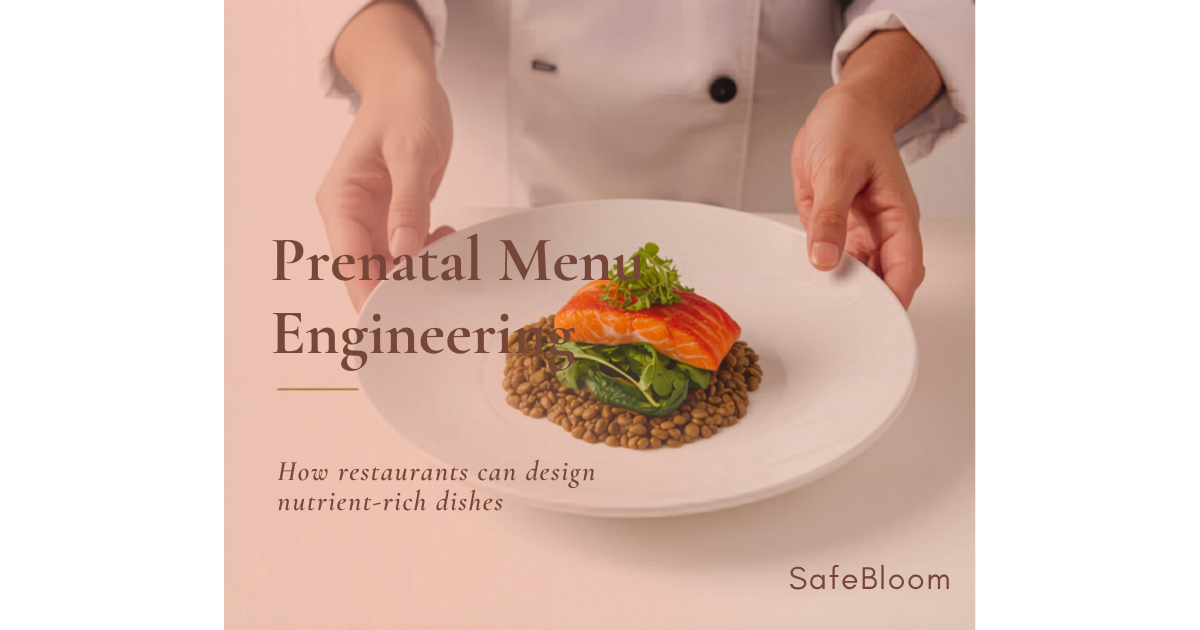
Menu execution: a roasted salmon main with seasonal vegetables is a low-effort, high-margin dish that delivers around 1.2g of omega-3 DHA per serving — exceeding the daily prenatal recommendation. Salmon is also widely accepted across cuisines, making it a flexible centerpiece.
5. Vitamin D
Best ingredient carriers: oily fish (cooked), egg yolks (fully cooked), UV-exposed mushrooms, fortified dairy.
Menu execution: position fully-cooked egg dishes (frittatas, baked eggs, shakshuka) as brunch staples that are explicitly pregnancy-safe. Communicate that yolks are cooked through — this is a small detail that builds enormous trust.
6. Iodine
Best ingredient carriers: cooked fish and shellfish, pasteurised dairy, cooked eggs, iodised salt.
Menu execution: using iodised salt as a kitchen standard is an invisible, zero-cost upgrade. Pair it with cooked seafood dishes for a meaningful nutritional contribution.
Building your prenatal menu section: three approaches
Approach A: The dedicated section
Create a clearly labelled “Pregnancy-Friendly” section on your menu with 3-5 dishes. Pros: maximum visibility, easy choice for guests. Cons: some pregnant women dislike feeling singled out.
Approach B: The icon system
Mark pregnancy-safe dishes throughout the regular menu with a small icon (a flower, a leaf, or the SafeBloom badge). Pros: integrates with the existing menu, gives the same range of choices as other guests. Cons: requires staff training so they can answer questions confidently.
Approach C: The hybrid
Use icons throughout the menu plus a small “For Expecting Guests” box on the back of the menu with a short paragraph: “Look for the flower icon. Every flagged dish uses pasteurised dairy, fully-cooked proteins, and is prepared with strict allergen separation. Ask your server for ingredient details.”
This is the approach most SafeBloom-certified restaurants converge on, because it balances visibility with dignity.
Operational rules that protect your menu and your guests
A prenatal menu is only as good as the kitchen discipline behind it. These are non-negotiable.
- Cook proteins to safe internal temperatures. Fish to 63°C / 145°F, ground meats to 71°C / 160°F, poultry to 74°C / 165°F. Use a probe thermometer, not visual judgment.
- Pasteurised dairy only on flagged dishes. Audit your cheese, milk, cream and yogurt suppliers and document pasteurisation status.
- Separate prep surfaces for raw and cooked. Cross-contamination is the leading cause of listeria outbreaks in food service.
- No raw or undercooked eggs in flagged dishes. That means no classical Caesar dressing, no tiramisù with raw egg, no carbonara unless the egg is tempered above 70°C.
- Listeria-safe deli meats: heat cured meats (prosciutto, salami) to steaming hot before serving, or omit them entirely from flagged dishes.
- Allergen documentation: every flagged dish needs a complete allergen card available on request.
Staff training: the multiplier
The single highest-leverage investment in a prenatal menu is staff training. A pregnant guest who asks “is this cheese pasteurised?” and gets a confident, accurate answer becomes a repeat customer. A guest who gets “um, I think so?” leaves and tells her network not to come back.
Train your service team to:
- Identify every flagged dish by memory
- Explain why each dish is pregnancy-safe in one sentence
- Confirm pasteurisation status for any dairy item
- Recommend pairings (e.g., a vitamin-C side with an iron-rich main)
- Handle the question “can you make X pregnancy-safe?” with a clear yes or no
The business case
Pregnant women dine out around 2-3 times per week on average, often as the deciding voice in family or friend group restaurant choices. A restaurant that earns trust during pregnancy retains that loyalty into early parenthood, when families are looking for safe, welcoming places to eat with children.
Beyond direct revenue, a prenatal menu also strengthens compliance with EU Regulation 1169/2011 on food information (allergen disclosure), improves your HACCP documentation, and creates a story you can use in marketing, PR and local press.
Get certified and get discovered
SafeBloom-certified restaurants get listed in our European directory, which is actively used by pregnant women looking for safe places to eat. Certification also gives your kitchen and service team a structured framework for executing everything in this article.
Explore the SafeBloom certification course to give your team the protocols, training and credentials to serve pregnant guests with confidence. Already certified? Access the marketing kit to communicate your prenatal menu to the women in your area.