
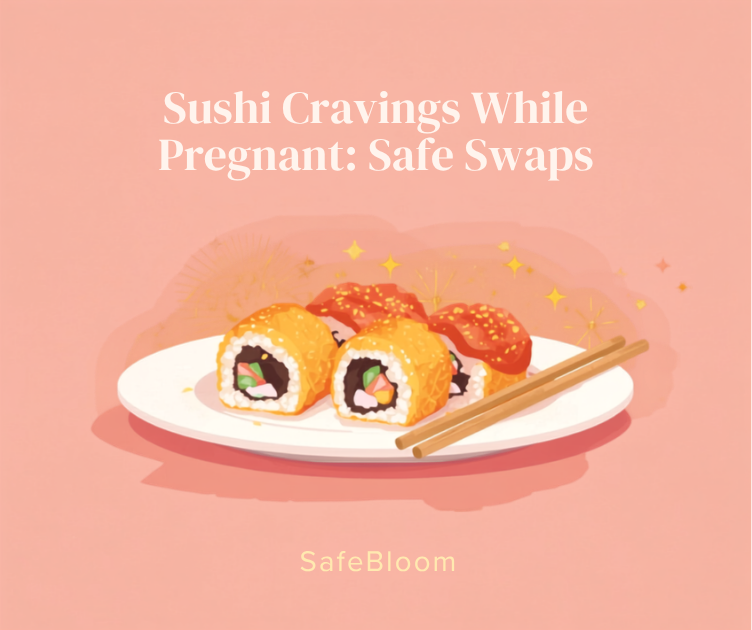
Few cravings hit harder during pregnancy than the one for sushi — and few foods come with more warnings. The good news: you don’t have to avoid Japanese restaurants for nine months. You just need to know which dishes are genuinely off-limits, which ones are perfectly fine, and how to swap your usual order for something equally satisfying and completely safe.
Why raw fish is the one rule that matters
The concern with sushi isn’t the rice, the nori or the soy sauce — it’s raw and cold-smoked fish. Two hazards drive the recommendation:
- Listeria monocytogenes can grow at refrigerator temperatures and, in pregnancy, can cross the placenta. Freezing raw fish (the standard practice for sushi-grade fish in the EU) kills parasites but does not eliminate Listeria.
- Parasites like Anisakis are neutralised by proper blast-freezing, but you’re relying entirely on the restaurant having done it correctly.
Because a Listeria infection during pregnancy is rare but serious, European food safety authorities advise skipping raw and cold-smoked fish altogether until after birth. That includes sashimi, nigiri with raw toppings, and — a detail many menus hide — cold-smoked salmon rolls.
The safe side of the sushi menu
Here’s what most people miss: a large part of a Japanese menu is already pregnancy-friendly. Fully cooked, freshly prepared and served hot means safe. Look for:
- Tempura rolls — prawn or vegetable tempura, deep-fried at high temperature
- Cooked eel (unagi) — always grilled and glazed, never raw
- California rolls made with cooked crab — check it’s real cooked crab or pasteurised surimi, kept properly chilled
- Chicken katsu, teriyaki dishes, gyoza and yakitori — fully cooked classics
- Vegetable rolls — avocado, cucumber, carrot; simple and safe
- Hot dishes — ramen with well-cooked toppings, udon, miso soup, edamame
Smart swaps for your favourite order
Craving something specific? There’s almost always a cooked equivalent with the same flavour profile:
- Salmon nigiri → seared-through salmon aburi (ask for it fully cooked) or a hot grilled salmon teriyaki
- Tuna roll → cooked prawn roll or chicken katsu roll — and you sidestep tuna’s higher mercury content too
- Sashimi platter → tataki is not the answer (it’s seared outside, raw inside); go for a grilled fish set instead
- Smoked salmon roll → tempura prawn roll with avocado
- Spicy tuna → spicy cooked shrimp with the same sriracha-mayo kick
Three questions to ask before you order
Even “cooked” items deserve a quick check. Staff at a good restaurant will answer happily:
- “Is every fish item in this roll fully cooked, not seared or smoked?” Aburi (torched) and tataki (seared) toppings are still raw inside.
- “Is the crab in the California roll cooked crab or surimi, and is it kept chilled?” Both are cooked products, but they must be handled cold-chain correctly.
- “Can you prepare my roll with freshly cooked ingredients rather than pre-sliced cold toppings?” Cross-contact with raw fish on the same cutting board is the hidden risk — a trained kitchen will use separate boards and knives.
That last point matters more than most guides admit: a vegetable roll cut on the same board as raw tuna isn’t truly risk-free. This is exactly the kind of protocol a certified kitchen has in place.
What about soy sauce, wasabi and ginger?
All fine. Pickled ginger, wasabi and soy sauce pose no specific pregnancy risk — though if you’re watching sodium, go easy on the soy. Green tea is fine in moderate amounts; just keep an eye on overall caffeine intake.
The easier route: pick a certified restaurant
Quizzing waiters about cutting boards isn’t everyone’s idea of a relaxing dinner. Restaurants certified by SafeBloom have already done the work: staff trained on pregnancy-safe protocols, separate preparation paths for raw and cooked items, and menus that clearly flag safe choices — so you can order your tempura roll without a cross-examination.
Browse the SafeBloom certified restaurant directory to find one near you, or check a specific venue on our certification verification page.
The bottom line
Pregnancy doesn’t mean farewell to Japanese food — it means nine months of tempura rolls, unagi and teriyaki instead of sashimi. Skip anything raw, seared or cold-smoked, ask about cross-contact, and choose kitchens that take the question seriously.
Run a restaurant? Learn how to serve pregnant guests safely — and win their loyalty — with the SafeBloom certification course, then promote it with our marketing kit.