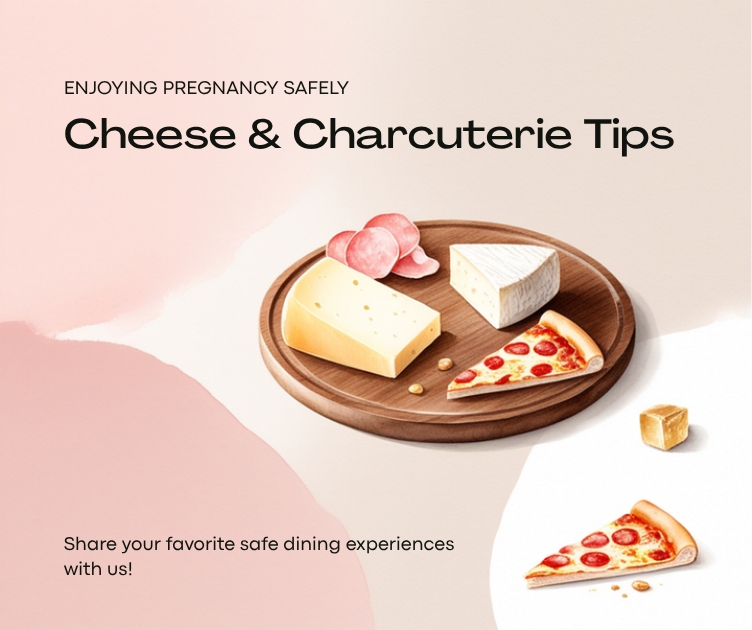
The cheese board arrives, the charcuterie platter follows, and suddenly a relaxed dinner turns into a guessing game. Is brie off-limits? What about the prosciutto on the pizza? Can you eat the burrata? Few categories of restaurant food cause as much confusion during pregnancy as cheese and cured meats, and few are as often mis-explained. This guide gives you clear, evidence-based rules so you can order with confidence, plus practical notes for restaurants that want to get it right.
Why cheese and charcuterie need special care in pregnancy
Two pathogens are behind almost every recommendation in this area.
Listeria monocytogenes is a bacterium that thrives in cool, moist, high-pH environments, which is exactly what a soft, mould-ripened cheese or a cold-cut counter provides. Unlike most food-borne bacteria, it keeps multiplying at refrigerator temperatures. Pregnant women are around ten times more likely than the general population to develop listeriosis, and the infection can cross the placenta even when the mother has only mild flu-like symptoms.
Toxoplasma gondii is a parasite found in raw and under-cured meat. Cured products such as salami and prosciutto are not cooked; curing and drying reduce the risk but do not guarantee elimination. In women who are not already immune, a first infection during pregnancy can affect the baby.
Understanding these two organisms explains every rule that follows: the question is never “is it cheese?” but “is it pasteurised, and is it cooked?”
Cheese: safe, safe-if-cooked, and best avoided
Safe as served
Any hard cheese is safe, whether made from pasteurised or unpasteurised milk. Low moisture and high acidity make Listeria growth practically impossible. That includes Parmigiano Reggiano, Grana Padano, Pecorino, aged Cheddar, Gruyère, Comté, Manchego and Emmental. The classic wedge of Parmesan over your pasta is entirely fine.
Pasteurised soft and fresh cheeses are also safe: mozzarella, ricotta, mascarpone, cream cheese, cottage cheese, halloumi, feta and paneer, provided the label or the restaurant confirms pasteurised milk. In the EU, most industrially produced fresh cheeses are pasteurised, but artisan versions may not be.
Safe only when cooked until steaming hot
Brie, Camembert, taleggio, gorgonzola, Roquefort and other mould-ripened or blue cheeses become safe when heated to at least 75 °C throughout. A baked Camembert served bubbling, a gorgonzola sauce simmered on the stove or a blue-cheese pizza straight from a hot oven is safe. The same cheese on a cold board is not.
Best avoided when dining out
Cold, uncooked mould-ripened soft cheeses and soft blue cheeses, regardless of pasteurisation, because their rind and moisture support Listeria growth after production. Also avoid any unpasteurised soft or semi-soft cheese, including artisan burrata, raw-milk mozzarella di bufala and fresh goat’s cheese, unless the restaurant can confirm the milk is pasteurised.
Charcuterie: the cured-meat rules
Avoid cold
Prosciutto crudo, Parma and San Daniele ham, Serrano and Ibérico ham, salami, chorizo, coppa, bresaola, pancetta and speck are all raw cured meats. Served cold on a board, wrapped around melon or laid over a salad, they carry a residual Toxoplasma and Listeria risk. Pâté, rillettes and other chilled meat spreads are also a recognised Listeria source and should be avoided even when made from cooked meat.
Safe when cooked
The same meats become safe once heated to steaming point. Crispy prosciutto on a hot pizza, chorizo cooked into a stew, pancetta rendered in a carbonara or speck baked into a gratin all pass the test. The rule of thumb: if it went into a hot oven or pan and came out hot, it is safe.
Safe as served
Fully cooked, pre-packaged deli meats such as cooked ham (prosciutto cotto), roast turkey and mortadella are lower-risk but still best eaten hot or from a freshly opened pack. Restaurants slicing them at a shared deli counter and holding them chilled for hours add Listeria risk, so when in doubt ask for them heated.
How to read a menu and ask the right questions
Three questions cover almost every situation:
- “Is this cheese made from pasteurised milk?”
- “Is the cheese or cured meat in this dish cooked, or added cold at the end?”
- “Can you serve this without the raw ham / with the cheese baked instead?”
Watch for common traps: a “caprese” with artisan buffalo mozzarella, a burrata starter, a pizza where the prosciutto crudo is laid on after baking, a Caesar salad with shaved raw-milk cheese, or a cheese course served at room temperature. None of these are dangerous by default, but each one deserves a question.
Safe orders by cuisine
- Italian: margherita with pasteurised mozzarella, lasagne, cacio e pepe, risotto with Parmesan, pizza with cooked ham. Skip the affettati board and cold burrata.
- French: gratin dauphinois, croque-monsieur, baked Camembert, quiche served hot, onion soup with Gruyère. Skip cold brie, pâté and rillettes.
- Spanish: tortilla, patatas bravas, chorizo cooked in cider, grilled Manchego. Skip cold jamón and cured chorizo slices.
- Greek and Middle Eastern: grilled halloumi, saganaki, spanakopita, hot feta in tomato sauce. Ask about pasteurisation on cold feta.
For restaurants: making cheese and charcuterie pregnancy-safe
Restaurants rarely need to remove dishes; they need to know their ingredients and offer a variant. Practical steps that also form part of the SafeBloom certification checklist:
- Record the pasteurisation status of every cheese on the menu and make it available to front-of-house staff.
- Offer a cooked version of cold cured-meat dishes: prosciutto crisped in the oven, salami baked onto the pizza.
- Keep deli meats and soft cheeses at or below 4 °C, date-label opened packs and discard after 3 days.
- Train servers to answer the three questions above without hesitation.
- Mark pregnancy-safe options on the menu so guests do not have to ask.
These measures cost almost nothing and turn a moment of anxiety into a moment of trust, the kind guests remember and share.
The bottom line
Cheese and charcuterie are not banned in pregnancy. Hard cheeses and pasteurised fresh cheeses are safe as served; soft mould-ripened and blue cheeses, and all raw cured meats, are safe only when cooked until steaming hot. Ask about pasteurisation, ask whether it is cooked, and choose restaurants where those questions are welcome.
Want to skip the guesswork? Find a SafeBloom-certified restaurant in our directory, where staff are trained and pregnancy-safe options are clearly marked. Running a restaurant? Discover the SafeBloom certification course and make your cheese board and charcuterie platter safe for every guest.