You are 24 weeks pregnant, it is your partner’s birthday, and a restaurant across town has a little pink badge on its Instagram page that says “pregnancy-safe certified”. Great. But what does that badge actually guarantee? Who checked? And how do you know it is still valid, or even real?
Trust is the whole point of certification, and trust has to be verifiable. This guide explains what a SafeBloom certification really covers, how to check it in under a minute, and how to tell a real certified restaurant from one that has simply borrowed the language.
What “pregnancy-safe certified” means at SafeBloom
Certification is not a marketing sticker a restaurant can buy. To be listed as a SafeBloom Certified Pregnancy-Safe Restaurant, a venue must complete the SafeBloom training course and demonstrate that its kitchen and front-of-house practices meet a specific protocol. In practice, that protocol covers four areas.
1. High-risk ingredients are identified and controlled
The kitchen knows which items carry listeria, toxoplasma or salmonella risk for pregnant guests: unpasteurised cheeses, cured or raw meats, raw or undercooked eggs, raw fish and shellfish, unwashed produce, and certain high-mercury fish. Each one is either excluded from marked dishes or handled with a validated safe method (for example, thorough cooking to a verified core temperature).
2. Cooking and holding temperatures are checked and recorded
“Well done” is an opinion; 75°C at the core is a measurement. Certified kitchens use probe thermometers on dishes intended for pregnant guests, and they log the readings. Chilled holding, reheating and cooling times follow the same logic: written parameters, not habit.
3. Cross-contamination is managed
A perfectly cooked steak sliced on the board that just held raw chicken is not safe. Certification looks at separation of raw and ready-to-eat foods, dedicated utensils and boards, hand-washing routines and cleaning schedules, with a focus on the surfaces where listeria tends to hide.
4. Staff can answer your questions
Front-of-house teams are trained to know which dishes are marked safe, what can be adapted, and what cannot. When you ask “is the hollandaise made with pasteurised eggs?”, a certified restaurant’s server should be able to answer, or know exactly who to ask.
What certification does not promise
Honesty matters here. No certification makes a restaurant risk-free, and SafeBloom does not claim that. It means the venue has been trained, has adopted a documented protocol, and has committed to maintaining it. It does not replace your own judgement or your midwife’s advice. If something on the plate looks or smells wrong, or a server seems unsure, you are always entitled to ask for a change or choose something else.
How to verify a certification in under a minute
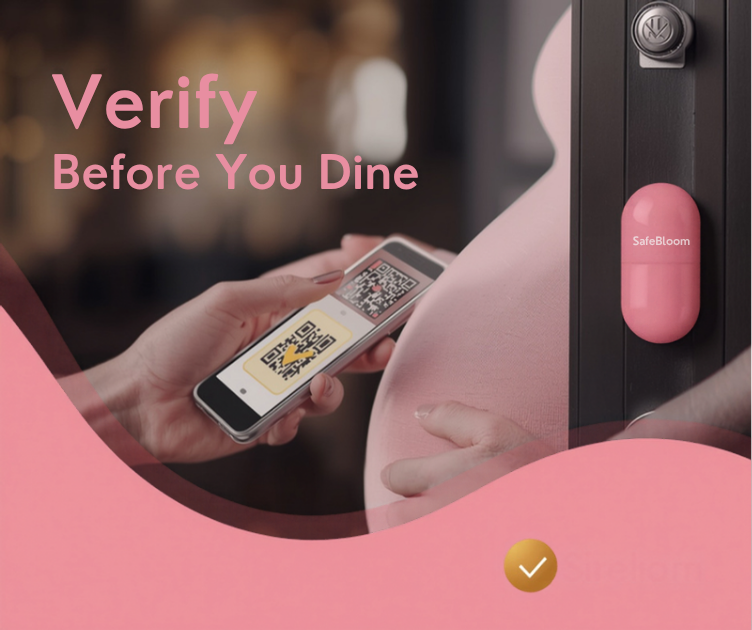
Every certified restaurant receives a unique certificate ID and a QR code, printed on the window decal and available on request. There are three ways to check it.
Scan the QR code
Point your phone camera at the badge on the door, the menu or the counter. It opens the SafeBloom certificate verification page showing the restaurant name, the certificate status and its validity dates. If the name on screen does not match the restaurant you are standing in, that is a red flag.
Search the directory
Before you book, open the SafeBloom certified restaurants directory and search by city or restaurant name. If a venue advertises SafeBloom certification but does not appear in the directory, it is either not certified or its certification has lapsed. Either way, ask them about it.
Ask for the certificate number
A certified restaurant will have it at hand. You can then enter it on the verification page yourself. A restaurant that cannot produce a number, or seems surprised by the question, probably has not been through the process.
Five signs of a real certified restaurant
Beyond the paperwork, certification shows in small, consistent behaviours. Look for these.
Marked dishes on the menu. A discreet icon next to specific dishes, with a short legend, rather than a vague “ask us about pregnancy options”. Confident, specific answers. “The salmon is cooked to 63°C at the core and we check it with a probe” is the answer of a trained kitchen; “it should be fine” is not. Willingness to adapt. Certified kitchens expect requests like “no raw egg in the dressing” or “could the burger be cooked through?” and handle them without fuss. Visible hygiene cues. Clean surfaces, staff washing hands, separate boards visible in an open kitchen. A badge that links somewhere. Real certification is verifiable online; a badge that is just an image, with no QR code or ID, deserves a question.
Signs the claim may be borrowed
Some restaurants mean well and genuinely try to accommodate pregnant guests without formal training. Others use the phrase “pregnancy-safe” because it attracts bookings. A few warning signs: the badge appears only on social media and not on the premises; nobody can tell you when the training happened or who took it; the “safe” recommendation is simply “avoid the raw stuff” with no detail on how cooked dishes are handled; or the restaurant is not in the public directory. None of these prove bad practice, but they do mean the safety claim is unverified.
What to do if a certified restaurant falls short
Certification is only meaningful if it is maintained. If you eat at a certified restaurant and encounter something clearly outside the protocol, such as a server who cannot tell you whether a cheese is pasteurised, or a “safe” dish served visibly undercooked, please tell the restaurant first, calmly and specifically; most issues are a training gap on one shift, not a policy. If the problem persists, report it through the SafeBloom verification page so the certification team can follow up with the venue. Feedback from pregnant diners is what keeps the standard real.
Why this matters for restaurants too
If you run a restaurant, everything above is good news. A verifiable certification is far more persuasive than a self-declared claim, precisely because guests can check it. The QR code on your door, the directory listing and the trained staff are what turn a cautious pregnant guest, and the table of family and friends she brings with her, into a loyal customer. The SafeBloom certification course covers the full protocol, and the marketing kit gives you the badges and materials to display it properly.
The one-minute checklist
Before you book: search the directory. At the door: scan the QR code and check the name. At the table: look for marked dishes and ask one specific question. If all three check out, relax and enjoy the evening. That is exactly what certification is for.
Planning a meal out? Find a SafeBloom certified restaurant near you, or verify a certificate right now.