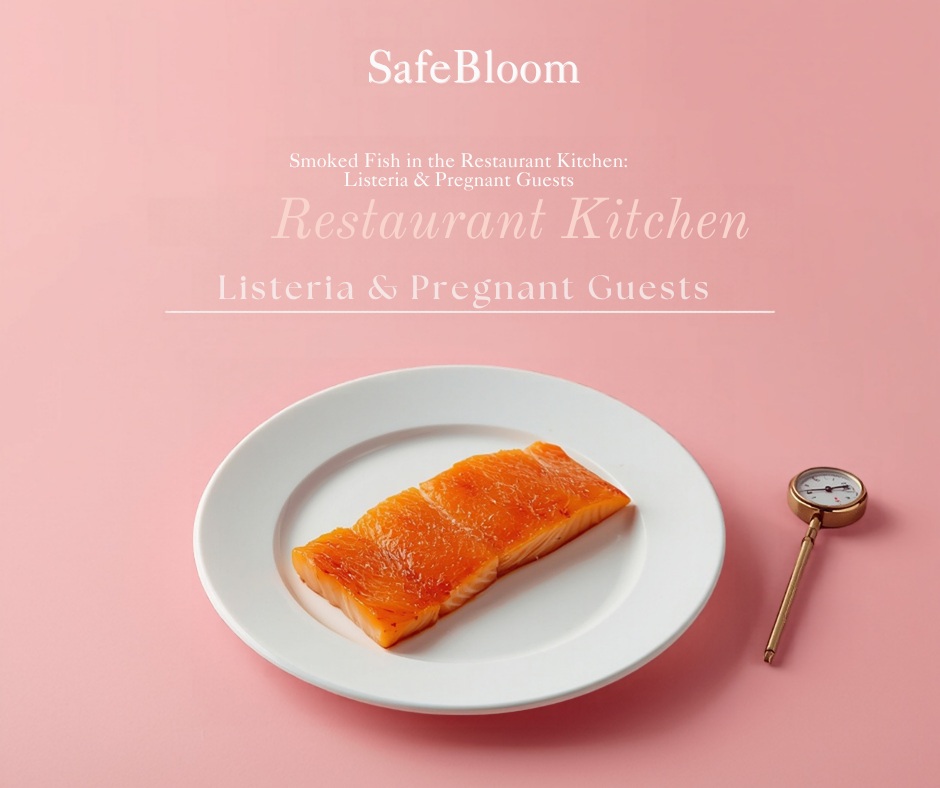
Smoked salmon is a menu favourite: brunch plates, canapés, festive starters, sandwiches. It is also one of the ready-to-eat foods that health authorities flag for pregnant guests. For a restaurant, the question is not whether to take it off the menu, but how to handle, label and offer it so that every guest can choose with confidence.
Why cold-smoked fish is a Listeria concern
Listeria monocytogenes can grow at refrigerator temperatures, and cold-smoked fish is never cooked during production. It is typically sliced, vacuum-packed, stored for days and served raw. According to EFSA and ECDC, ready-to-eat fishery products of this kind are a recurring source of listeriosis cases in Europe, and pregnant women are among the most vulnerable groups. The NHS and Italy’s ISS (EpiCentro) advise pregnant women to avoid cold-smoked or cured fish eaten raw, such as smoked salmon, smoked trout and gravlax, unless it is cooked until piping hot.
What EU rules already ask of you
Regulation (EC) No 2073/2005 sets microbiological criteria for Listeria monocytogenes in ready-to-eat foods that can support its growth. Producers must meet limits throughout the product’s shelf life, and food business operators are responsible for storing and handling the product so those limits are not compromised after delivery. Compliance with this rule is the baseline. It does not tell a pregnant guest which dishes are right for her, and that is where clear menu communication comes in.
A practical handling protocol
1. Receiving and storage
Check the temperature and use-by date on delivery, reject damaged packaging, and store at the temperature stated on the label. Keep smoked fish separate from raw meat and raw fish, and never use it past its use-by date. Once a vacuum pack is opened, label it with the date and time and follow the producer’s instructions on how long it can be kept.
2. Slicing and portioning
Use dedicated, cleaned and sanitised boards, knives and gloves. Slicers and boards that have touched raw products are a classic cross-contamination route. Portion to order where possible, rather than pre-slicing large batches that sit in the fridge.
3. Service and display
On a buffet or brunch counter, keep smoked fish on ice or in a chilled display, replace it in small quantities, and remove it after the time limit set in your HACCP plan. Anything left on a warm counter should be discarded, not returned to the fridge.
4. Cleaning and verification
Include fridges, vacuum sealers and slicers in your cleaning schedule, and record temperatures. A written log is what shows, to an auditor or to your own team, that the procedure really happens.
Menu communication that helps pregnant guests
- Label the preparation: “cold-smoked, not cooked” or “hot-smoked, cooked” is far more useful than “smoked salmon”.
- Offer a cooked alternative: baked or pan-seared salmon in the same dish, or the smoked fish folded into a hot dish that reaches steaming temperature throughout.
- Train front-of-house staff: they should be able to answer “is this raw or cooked?” without checking with the kitchen every time.
- Be honest about what you do not know: if a supplier’s product details are unclear, say so and suggest a safer dish.
The business angle
A guest who asks about smoked fish and gets a clear, confident answer remembers it. A guest who gets a shrug does not return. Treating this as a routine part of service, rather than an exception, builds trust with expectant mothers and everyone dining with them.
SafeBloom’s certification is a training mark: an 8-hour online course in four modules, a 15-question final exam (80% pass mark) and 12 months of validity. It is not a sanitary inspection, and SafeBloom does not audit kitchens. What it does give your team is a shared vocabulary and a set of procedures for foods exactly like this one.
Key takeaways
Cold-smoked fish is a high-attention ready-to-eat item: control temperature and time, separate equipment, label the preparation clearly, and always have a cooked alternative ready. Final dietary decisions for individual guests should rest with their own healthcare provider.
Ready to train your team? Explore the SafeBloom certification course, read our method, visit the page for restaurateurs or see how guests find venues in the Restaurant Finder.
Sources: EFSA, ECDC, NHS, ISS/EpiCentro, Regulation (EC) No 2073/2005. Informational only; not medical advice.