Ask any kitchen manager what keeps them up at night and the answer is rarely a broken oven. It is the invisible stuff: bacteria, viruses and parasites that travel from one surface to the next on a pair of hands. For pregnant guests, who are more vulnerable to infections such as listeriosis and toxoplasmosis, hand hygiene is one of the cheapest and most effective protections a restaurant can offer.
This guide sets out a practical hand hygiene and glove protocol for restaurant kitchens and dining rooms. It is written for owners, chefs and shift leaders who want a routine their team will actually follow.
Why hands matter so much in food safety
Hands touch raw ingredients, packaging, bins, phones, door handles, money and then, a few minutes later, a plate that will not be cooked again. According to the European Food Safety Authority (EFSA), infected food handlers are a recognised source of foodborne outbreaks, norovirus being the best-known example. The NHS and Italy’s ISS/EpiCentro both list hand washing after handling raw meat, unwashed vegetables or soil among the basic precautions for pregnancy, because it helps reduce the risk of toxoplasmosis and other infections.
A restaurant cannot control what a guest ate at home, but it can control whether the food that arrives at the table has been touched by clean hands.
The legal baseline in the EU
Regulation (EC) No 852/2004 on the hygiene of foodstuffs requires food business operators to ensure that people working in food-handling areas maintain a high degree of personal cleanliness, and that washbasins for cleaning hands are available, suitably located, supplied with hot and cold running water, cleaning materials and hygienic drying. A hand basin that is blocked by a stack of pots, or has no soap, is a compliance gap, not a detail.
Compliance is the floor. A pregnancy-friendly kitchen goes further by making hand hygiene a written, trained and checked routine.
When staff must wash their hands
The list below works well when it is printed and fixed above every hand basin:
- When entering the kitchen, at the start of every shift and after every break
- After using the toilet
- After handling raw meat, poultry, fish, eggs or unwashed vegetables, and before touching anything ready to eat
- After touching bins, cleaning products, deliveries or packaging
- After coughing, sneezing, touching the face or hair, or using a phone
- After handling money or payment terminals, when the same person also serves food
- Between different allergen-containing tasks, to avoid cross-contact
The technique: simple, but often rushed
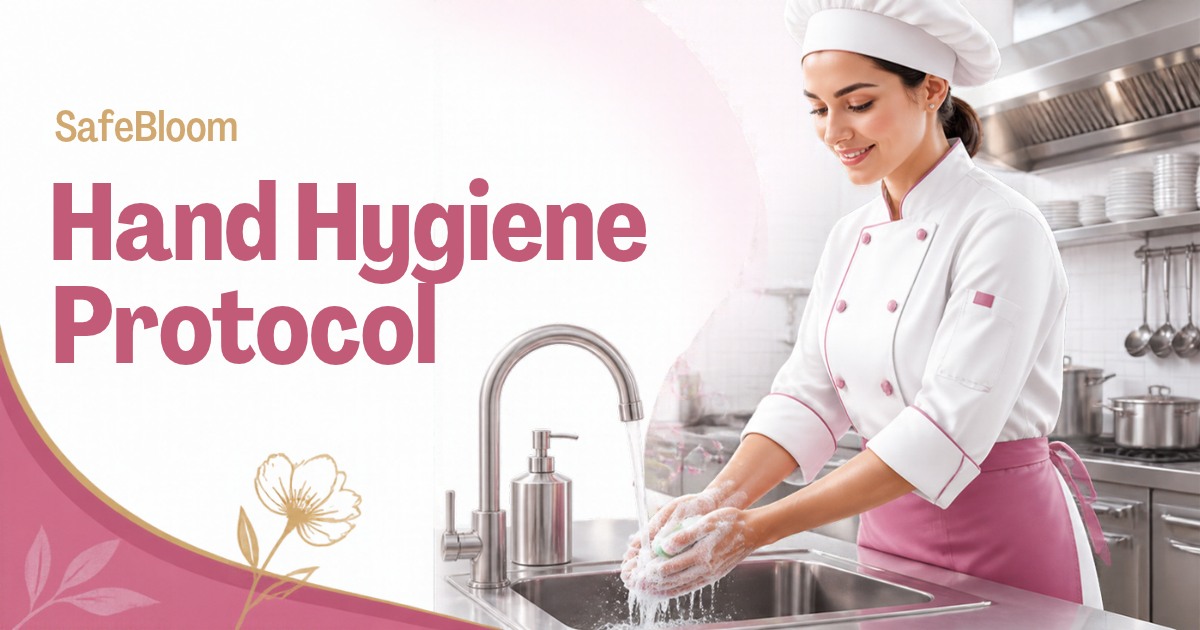
The World Health Organization recommends washing with soap and water for around 40 to 60 seconds, covering palms, backs of hands, between fingers, thumbs and fingertips, then rinsing and drying with a single-use towel. Alcohol-based hand rub is useful in the dining room, but it is not a substitute for washing when hands are visibly dirty or have touched raw food. Taps that can be closed with the elbow or a paper towel avoid re-contaminating clean hands.
Gloves: helpful, but not a substitute
Gloves are often seen as a safety guarantee. In practice, a glove worn through five different tasks spreads contamination just as efficiently as a bare hand, and it can give a false sense of security. A sensible policy looks like this:
- Wash hands first, then put on gloves; never the other way round
- Change gloves between raw and ready-to-eat tasks, after any interruption, and whenever they are torn or dirty
- Use colour-coded gloves where possible, for example blue for ready-to-eat food, to make errors visible
- Cover cuts and plasters with a waterproof, coloured dressing, then glove over it
- Gloves are for tasks, not for the whole shift: wash hands again after removing them
Dining room and front of house
Hand hygiene is not only a kitchen issue. Waiters carry plates, bread baskets, menus and cutlery, and handle used crockery. Practical points include:
- A hand basin or sanitising station near the pass, so staff can clean hands after clearing tables
- Cutlery and glasses handled by the stem or handle, not by the part that touches the mouth
- Bread, butter portions and garnishes served with tongs or from covered containers
- Menus and table surfaces cleaned regularly; a pregnant guest should not have to ask
Make it a system, not a speech
Written rules fail if nobody checks them. Add three habits to your existing HACCP routine:
- Train and re-train. Show the technique at induction, then refresh it every few months with a two-minute demonstration at the pre-service briefing.
- Check the basics daily. Is there soap, paper towel and hot water at every basin? Is each basin free of clutter? Record it on the opening checklist.
- Link it to illness policy. Staff with vomiting or diarrhoea should stay away from food handling, in line with the guidance of national food safety authorities. Hand hygiene cannot compensate for an infected worker on the line.
What SafeBloom does and does not do
The SafeBloom certification is a training mark: restaurant teams complete an 8-hour online course across four modules and pass a final 15-question exam (80% threshold), valid for 12 months. SafeBloom does not inspect kitchens, so a certificate is not a substitute for your own checks. What it gives your team is a shared vocabulary and a routine for the situations a pregnant guest cares about, including personal hygiene, cross-contamination and clear communication at the table. You can read how the approach works on our method page.
This article is general information and does not replace advice from a doctor or midwife, or from your local food safety authority.
Next step
If you run a restaurant and want your team to handle pregnant guests with confidence, explore the SafeBloom certification course or visit our page for restaurateurs. If you are expecting and looking for a place to eat, start with the Restaurant Finder.