
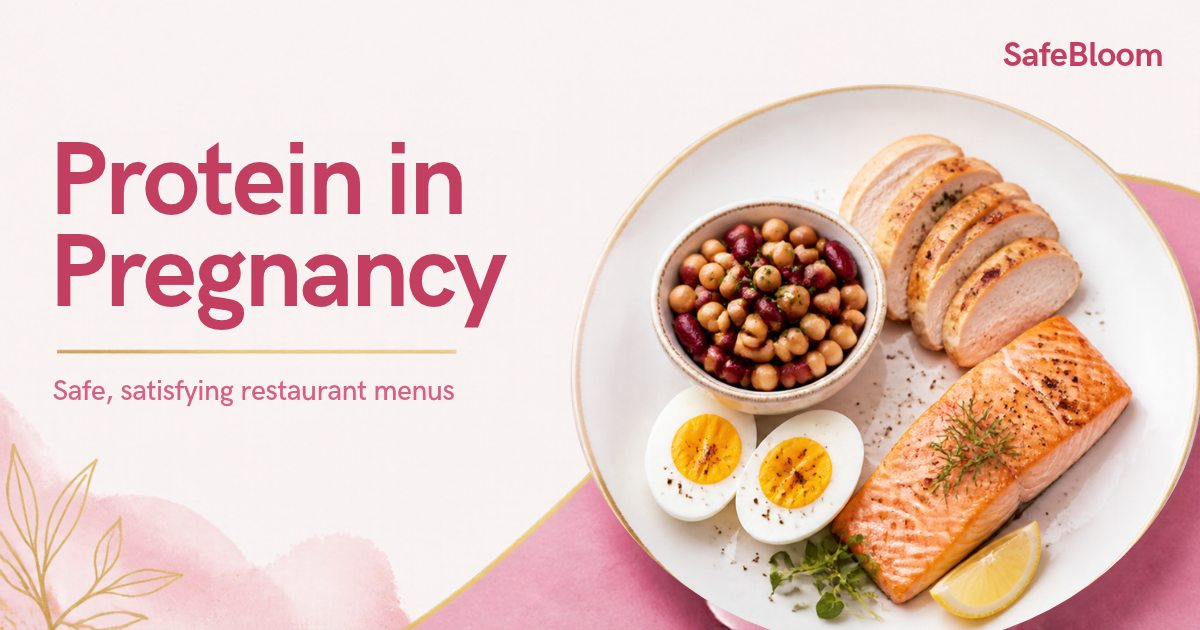
When restaurants think about pregnancy, they usually think about what to remove from the menu: raw fish, soft cheese, runny eggs. But a pregnant guest also needs something to eat, and protein is the nutrient she is most likely to struggle to find in a safe, satisfying form. This guide helps kitchens design protein-rich dishes that work for pregnant guests without a separate menu.
Why protein matters on the plate
Protein supports the growth of fetal tissue, the placenta and the mother’s expanding blood volume. The European Food Safety Authority (EFSA) sets the reference intake for adults at about 0.83 g per kg of body weight per day and recommends an additional intake during pregnancy of roughly 1 g/day in the first trimester, 9 g in the second and 28 g in the third. The practical message for a menu: protein should be present in every main course, and portions matter most for guests in late pregnancy.
Individual needs vary, so guests with specific medical conditions should follow the advice of their own healthcare professional.
Five protein families and how to serve them safely
1. Poultry and meat: cook through, label clearly
Poultry, beef, pork and lamb are rich in complete protein, iron and vitamin B12. The risks, including Salmonella, Listeria and Toxoplasma gondii, are controlled by heat. Cook to a core temperature your HACCP plan defines (commonly 70–75 °C) and log it. Mark rare-cooked dishes, tartare and carpaccio clearly, and make sure staff can offer a well-done alternative without embarrassment.
2. Fish and seafood: the right species, always cooked
Fish brings protein, iodine and omega-3. Public health bodies such as EFSA and the NHS advise pregnant women to limit large predatory fish like swordfish, shark and marlin because of mercury, and to avoid raw fish. A menu can highlight cooked options such as baked sea bream, grilled sea bass or well-cooked salmon, and flag raw or cold-smoked items so guests can choose with confidence.
3. Eggs: cooked sets, pasteurised for raw uses
Eggs are a cost-effective protein and a source of choline. Hollandaise, homemade mayonnaise, mousse and tiramisu are the hidden-risk dishes. Using pasteurised egg for any preparation that is not fully cooked, or offering a fully cooked version, removes the issue and costs little.
4. Legumes and plant proteins: the easy win
Lentils, chickpeas, beans and peas provide protein, fibre, iron and folate, and are generally safe when well cooked and served hot. Watch two points: cool and store batch-cooked soups and stews properly to prevent Bacillus cereus growth, and never serve raw sprouts as a garnish. A hot lentil soup or a well-heated falafel bowl suits vegetarian and omnivorous pregnant guests alike.
5. Dairy and alternatives
Pasteurised yoghurt, hard cheeses and cooked dishes with pasteurised cheese are generally fine. Raw-milk and mould-ripened soft cheeses should be avoided in line with ISS and NHS guidance. Tofu is a good plant option when thoroughly heated.
Building a pregnancy-friendly protein section
- Label the cooking method. “Baked”, “grilled well done”, “pasteurised egg” help guests decide in seconds.
- Offer a swap. Let guests exchange a raw or cold item for a cooked one at no extra charge.
- Keep a hot-hold and cooling log. Protein dishes are the most temperature-sensitive items on the pass.
- Prevent cross-contamination. Separate boards and utensils for raw meat, fish and ready-to-eat items.
- Brief the floor team. A server who can answer “is this egg cooked?” earns trust instantly.
Smaller portions, higher quality
Many guests in the first trimester experience nausea and cannot finish large plates. Offer half portions of high-protein dishes: a firmly set egg dish, a chicken broth with pasta, or a lentil purée. These are inexpensive, low-waste and appreciated.
Where SafeBloom fits in
SafeBloom is a training mark, not a health inspection. Restaurant teams complete an 8-hour online course in four modules and pass a 15-question final exam (80% threshold); the certificate is valid for 12 months. SafeBloom does not audit kitchens, but the training gives your team shared knowledge and a common language for serving pregnant guests. You can learn more about our method and the restaurant programme.
Key takeaways
Protein is the part of the pregnancy menu you can say yes to. Cook thoroughly, choose the right fish, replace raw egg with pasteurised egg, and label clearly. These small decisions let pregnant guests order confidently, and they cost far less than the confusion of a menu built only around restrictions. This article is general information and not medical advice.
Ready to train your team? Discover the SafeBloom certification course, or help guests find you through the Restaurant Finder.